
Spaced Repetition for PANCE and EOR Prep
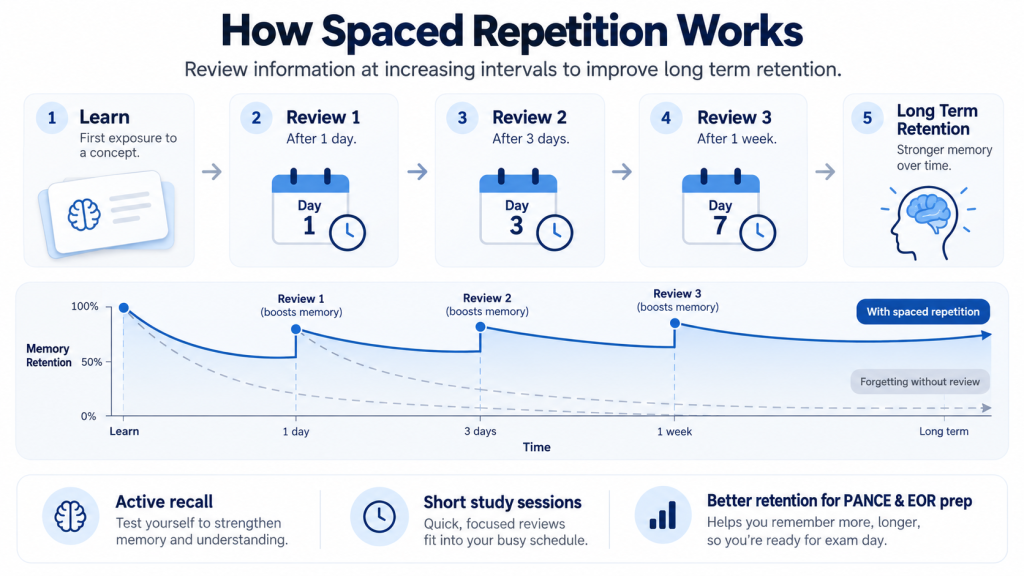
Spaced repetition for PANCE prep and EOR prep can help PA students retain high-yield clinical information more efficiently by reviewing material at increasing intervals over time.
One evidence-based study strategy that can help is spaced repetition.
Spaced repetition is a learning method that reviews information at increasing intervals over time rather than repeatedly studying the same material in one sitting. The goal is to revisit information just as it begins to fade from memory, strengthening long-term retention with each review.
For PA students balancing didactic coursework, clinical rotations, EOR exams, PACKRAT, and eventually the PANCE, this can be an efficient way to maintain knowledge over time.
Maye JA, Hurley F. The Effectiveness of Spaced Repetition in Medical Education: A Systematic Review and Meta-Analysis. Clin Teach. 2026 Apr;23(2):e70353. doi: 10.1111/tct.70353. PMID: 41601436.
What Is Spaced Repetition?
Spaced repetition is based on a simple principle:
Information is remembered better when review is distributed over time.
Instead of studying the same topic repeatedly in one long session, spaced repetition brings the material back at strategically timed intervals.
For example, a student learning about aortic stenosis might review the concept:
Today
Several days later
Again the following week
Later in the month
Concepts that are difficult can appear more frequently, while information that is consistently recalled correctly can be reviewed less often.
This allows study time to be concentrated on material that still needs reinforcement.
Why Spaced Repetition Can Be Effective
Medical education requires students to retain thousands of facts, clinical associations, diagnostic criteria, medications, and treatment decisions.
Research in health professions education has found that both spaced practice and active retrieval can improve learning outcomes compared with more traditional study approaches.
The benefit comes from repeatedly requiring the learner to retrieve information from memory, rather than simply rereading it.
Each successful retrieval strengthens the memory pathway and makes future recall easier.
Instead of asking:
“Have I seen this before?”
Spaced repetition encourages the learner to ask:
“Can I recall this without looking at the answer?”
That distinction is important when preparing for exams that require rapid recognition and clinical reasoning.
Spaced Repetition vs Cramming
Cramming can create a feeling of familiarity with the material, but familiarity does not always translate into durable recall.
A student may study cardiology intensively for several hours and perform well the next day, but much of that information may fade if it is not revisited.
Spaced repetition distributes that review across days and weeks.
Instead of:
4 hours of cardiology on one night
a student might complete:
20 minutes of cardiology review several times over the next few weeks.
The total study time may be similar, but the repeated retrieval opportunities help reinforce long-term memory.
Why Spaced Repetition Fits PA Education
PA students are expected to move rapidly between different areas of medicine.
During one week, you may be reviewing:
Cardiovascular disease
Pulmonary medicine
Infectious disease
Dermatology
Pharmacology
Emergency medicine
Preventive care
Then a clinical rotation may require an entirely different emphasis.
Without continued review, previously learned material can fade.
Spaced repetition allows older concepts to remain part of your study routine while you continue learning new information.
That makes it particularly useful during both the didactic and clinical phases of PA education.
Using Spaced Repetition for PANCE Prep
The PANCE covers a broad range of medical content and clinical tasks. The NCCPA blueprint includes multiple organ systems along with areas such as history and physical examination, diagnosis, diagnostic studies, clinical intervention, pharmaceutical therapeutics, and health maintenance.
Because of this breadth, trying to relearn everything immediately before the exam can be overwhelming.
Spaced repetition can help by keeping major concepts active throughout PA school.
For example:
Week 1: Review heart failure
Week 2: Revisit heart failure while studying valvular disease
Week 4: Review heart failure again through flashcards
Week 8: Encounter the topic again in exam-style questions
By the time dedicated PANCE preparation begins, the material has already been retrieved multiple times.
Using Spaced Repetition for EOR Exams
PAEA End of Rotation exams assess knowledge gained during specific supervised clinical practice experiences and use clinical vignette-style questions.
Instead of waiting until the final week of the rotation to study, spaced repetition allows students to review throughout the rotation.
A simple approach might look like:
Early in the rotation
Build familiarity with common diagnoses, medications, and clinical presentations.
Mid-rotation
Continue reviewing previous material while adding new topics encountered clinically.
Two weeks before the EOR
Increase exam-style questions and focus more heavily on weaker areas.
Final days before the exam
Review difficult concepts, missed questions, clinical pearls, and high-yield associations.
This approach can reduce reliance on last-minute cramming.
Active Recall Makes Spaced Repetition More Powerful
Spaced repetition works particularly well when paired with active recall.
Active recall means attempting to retrieve information before looking at the answer.
For example:
Question: What physical examination finding is associated with an Achilles tendon rupture?
Try to answer before revealing:
Answer: Positive Thompson test.
That retrieval attempt is more valuable than simply rereading:
“Thompson test = Achilles tendon rupture.”
This is why flashcards can be particularly useful when they require the learner to think before revealing the answer.
How Flash Review Applies Spaced Repetition
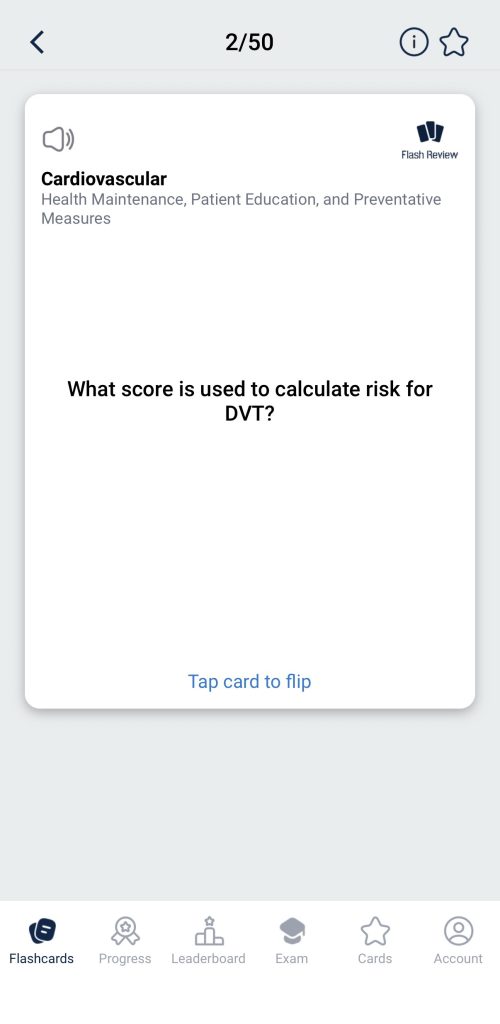
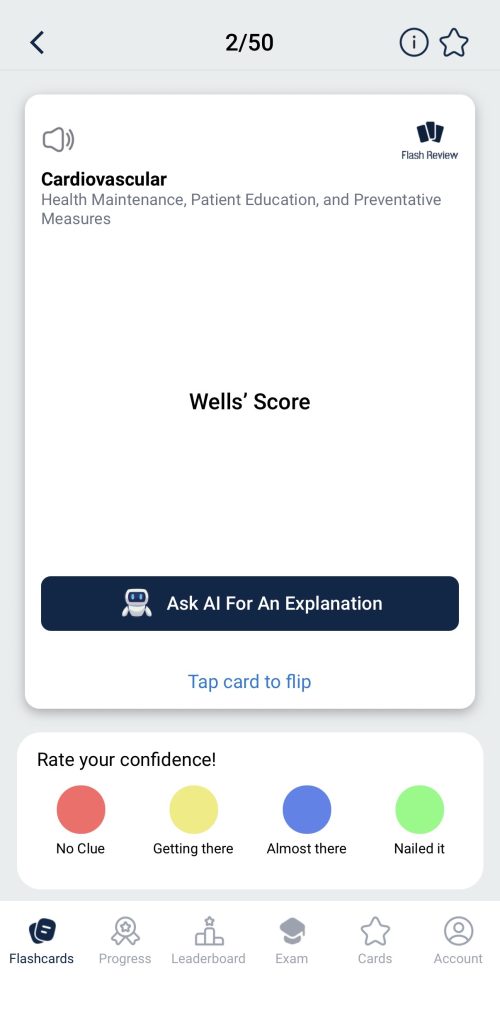
Flash Review was designed to help PA students incorporate active recall and repeated review into short study sessions by rating your own confidence.
Students can choose content based on:
PANCE Blueprint topics
End of Rotation content
Medical specialty
Areas they want to review
Flashcards require the learner to retrieve the answer before flipping the card.
Rather than relying only on passive reading, Flash Review encourages repeated interaction with high-yield clinical information.
As students continue studying, concepts can be revisited over time, helping reinforce information that may otherwise be forgotten.
Study in Short Sessions
One of the advantages of digital spaced repetition is that studying does not always require a long dedicated session.
Flash Review can be used during:
A break between classes
Downtime during a clinical rotation
A commute on public transportation
The evening after a shift
A few minutes before bed
Dedicated PANCE or EOR study sessions
Even brief periods of active review can contribute to a larger, consistent study routine.
Combine Flashcards With Exam-Style Questions
Spaced repetition is most useful when it is part of a broader study strategy.
Flashcards are excellent for reinforcing:
Clinical presentations
Diagnostic findings
Medications
Treatment choices
Physical examination signs
Laboratory patterns
High-yield associations
Exam-style questions then require the student to apply that information to a clinical scenario.
Flash Review combines these approaches so students can move from:
Recall → Recognition → Clinical Application
That progression more closely reflects the type of thinking required on PANCE and EOR examinations.
A Simple Spaced Repetition Study Strategy
Try this approach during your next rotation or PANCE study period:
Daily
Complete a short flashcard review.
Several times per week
Answer exam-style questions in the topics you are currently studying.
Weekly
Review weaker areas and missed concepts.
Before the exam
Increase practice questions while continuing spaced review of difficult material.
Consistency is more important than completing extremely long study sessions.
Spaced Repetition Is Not About Memorizing Everything
The goal is not to memorize every isolated fact.
The goal is to repeatedly reinforce the clinical information that PA students are expected to recognize and apply.
For example:
Chest pain + ST elevation → recognize STEMI
Flashes + floaters + curtain over vision → recognize retinal detachment
Needle-shaped negatively birefringent crystals → recognize gout
Repeated exposure helps these associations become easier to retrieve when they appear in clinical vignettes.
Build Long-Term PA Knowledge
Studying for an EOR exam should not only help you pass the next test.
The same information will appear again during:
Future rotations
PACKRAT
PANCE preparation
Clinical practice
Spaced repetition allows the studying you do today to continue contributing to your knowledge later.
Instead of repeatedly starting over, you continue building on what you have already learned.
Start Using Spaced Repetition With Flash Review
Flash Review gives PA students a convenient way to incorporate active recall, high-yield flashcards, exam-style questions, and repeated review into their study routine.
Whether you are preparing for your next EOR exam or building toward the PANCE, consistent review can help turn short study sessions into stronger long-term retention.
Start studying with Flash Review today.

